

Version 1.0 — Published June 2026 | Reviewed by X.One® Engineering Team | Verification window: Q2 2026 industry data and certifications
QUICK ANSWER
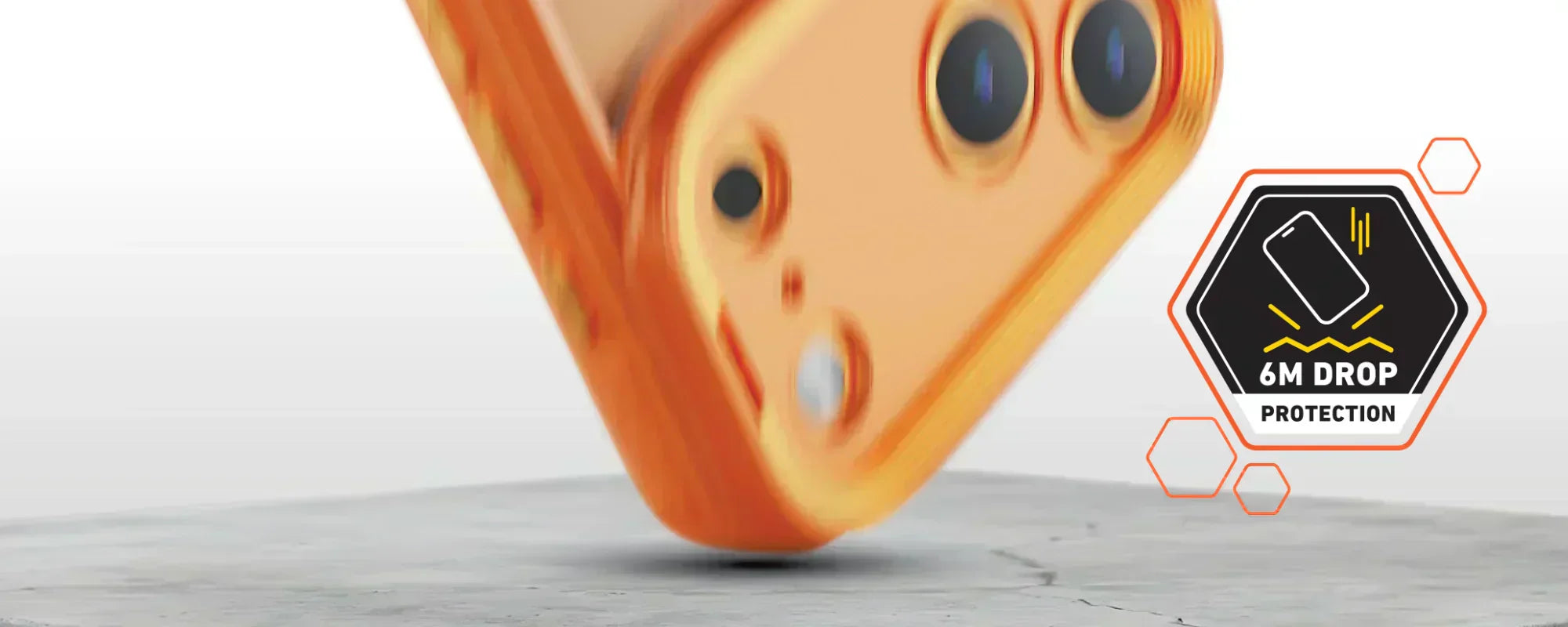
DNA Guard™ is X.One®'s proprietary drop protection technology. It uses a honeycomb structural design inside the case to absorb up to 95% of impact force and disperse it across the case body before it reaches the phone. Cases built with DNA Guard™ are drop-tested and SGS-certified to 20 feet (6 metres) — significantly above the 4–5 foot threshold of the common MIL-STD-810 standard. The technology has been in development for over 15 years and is engineered into X.One®'s Dropguard Pro, Dropguard 2S, Shock Dominator, and Dropguard Clear case lines.
The $149 Billion Question Nobody Wants to Answer
Last year, 78 million Americans damaged their smartphone. The collective US repair bill since the smartphone was invented now sits at $149 billion, according to Allstate Protection Plans' 2024 Mobile Mythconceptions Study. The average single repair? $302.
Here's the part most people miss: 80% of smartphone owners already use a case — and yet 21% report damaging their phone while it was inside one. A case is not a guarantee. The case is a system — and how that system manages the energy of an impact decides whether your screen survives or your wallet doesn't.

This is the gap DNA Guard™ Technology was built to close. Not by making cases thicker. By making them smarter.
What is DNA Guard™ Technology?
DNA Guard™ is a proprietary impact protection technology developed by X.One® that combines a precision-engineered honeycomb structural design with a proprietary shock-absorbing material to deliver up to 20-foot (6-meter) drop protection without adding bulk to the case.
The technology took more than 15 years of research and field testing to refine. It is the structural backbone behind every modern X.One® impact protection case — engineered into the case shell rather than added as a separate liner — and is independently certified by SGS and TÜV Nord.
The technology has three jobs, in this order:
- Absorb — soak up the kinetic energy of an impact before it travels into the phone
- Disperse — spread that energy across the entire case body, preventing single-point pressure on any one section of the device
- Dissipate — convert the absorbed energy into heat and elastic deformation, then return the case to shape
Most cases on the market do step one only. DNA Guard™ does all three — which is why a 20ft drop test result with DNA Guard™ is not the same physical event as a 20ft drop test without it.
The Science: Why Honeycomb Structures Beat Solid Padding
The honeycomb pattern isn't decorative. It's one of the most efficient energy-absorbing geometries known to engineering. Honeycomb structures are used in aircraft wings, satellite components, automotive crumple zones, and packaging for fragile cargo — and they've been peer-reviewed in materials science journals for decades.
When a honeycomb structure is hit, it does something solid materials can't: it exhibits what engineers call sustained plateau stress. Instead of the impact force spiking sharply and transferring straight through to whatever is behind it (your phone), the honeycomb cells progressively collapse and recover, holding the force at a steady, manageable level for the duration of the impact event.
In plain English: the honeycomb stretches the impact out over more time. And longer impact = lower peak force. That's the same principle car airbags use, the same principle helmets use, and the same principle that protects astronauts during atmospheric re-entry.

Close-up profile of X.One® DNA Guard™ structural layout. The geometric cell pattern acts as a protective buffer, reducing concentrated impact energy by up to 95%.
There's another reason this matters specifically for phones: over 70% of drop failures originate at the case corners. When a phone falls, it almost never lands flat — it hits at an angle, and a corner takes the full brunt. A solid case has nowhere to put that energy. A honeycomb structure, paired with X.One's proprietary Edge Guard at the corners, gives that energy somewhere to go.
How DNA Guard™ Works in a Real Drop
When your phone slips out of your hand and hits the ground, the entire protective sequence happens in less than 3 milliseconds. Here's what's actually going on inside a DNA Guard™ case during that fraction of a second:
Stage 1: Edge Guard — First Line of Defense (0–1ms)
The reinforced corners of the case make contact with the ground first. The Edge Guard's raised, denser structure deflects and reduces the initial kinetic energy before it can travel into the rest of the case. Think of this like the bumper on a car — designed specifically to take the first hit so the rest of the structure doesn't have to.
Stage 2: DNA Guard Honeycomb — Energy Dispersion (1–2ms)
Once force enters the case body, it meets the honeycomb structural matrix. Each hexagonal cell flexes and transfers a portion of the load to the cells next to it, then those cells transfer to the next, and so on — fanning the impact outward across the back and sides of the phone in a wave pattern. By the time the energy reaches the phone itself, it's been redistributed across a surface area many times larger than the original impact point.
Stage 3: Material Absorption & Recovery (2–3ms)
X.One's proprietary shock-absorbing material — engineered to be elastic without being soft — converts the residual energy into heat through controlled deformation, then snaps back to its original shape. The case is now ready for the next drop. The structure absorbs up to 95% of the original impact force; only a small remainder makes it into the phone itself.
DNA Guard™ Performance Breakdown
Here's what 15 years of engineering iteration produced, in numbers:
| Performance Metric | DNA Guard™ Result | What It Means |
|---|---|---|
| Impact force absorbed | Up to 95% | Only ~5% of the kinetic energy reaches your phone |
| Drop protection increase | +20% | Compared to non-DNA-Guard cases of equivalent thickness |
| Certified drop height | 20 ft (6 meters) | ~3 stories — independently SGS-tested |
| Test angles | All 6 faces, 12 edges, 8 corners | Exceeds MIL-STD 26-drop sequence |
| Years in development | 15+ years | Continuous R&D iteration since X.One®'s founding |
| Bulk added to case | Zero (engineered into shell) | Slim profile, full protection |
"Military-Grade" — What the Label Actually Means (and Doesn't)
This deserves a straight answer because the phone case industry has spent years muddying it: there is no military body that tests phone cases.
When a case claims "MIL-STD-810G certified," it means the manufacturer says it designed the case to survive the procedures listed in a publicly available US Department of Defense document. The standard most cases reference, MIL-STD-810G Method 516.6, was published in 2008 and requires surviving 26 drops from 4 feet (48 inches) onto plywood-backed concrete.
In 2019, the Department of Defense updated this to MIL-STD-810H Method 516.8, which raised the bar to 5 feet onto concrete-backed steel. Most case manufacturers still use the older, looser 2008 version.
Here's what's worth knowing:
- The 4ft MIL-STD threshold has become "table stakes" — most basic TPU cases on the market today can technically pass it
- No third-party body verifies most "MIL-STD" claims on consumer products
- "Military-grade" tells you the manufacturer tried to meet a 4ft test. It doesn't tell you the case is independently certified, or that it would survive a real drop higher than that.
X.One® takes a different approach. DNA Guard™ cases are certified by SGS — one of the world's largest independent testing organizations, based in Switzerland — to survive drops from 6 meters (20 feet). The previous generation was certified by TÜV Nord (Germany) at 10 feet. That's third-party verification, on real lab equipment, by an organization that has no commercial relationship with the brand. It's a different standard than self-attested MIL-STD claims.
How DNA Guard™ Compares to Common Drop Standards
| Standard | Drop Height | Test Surface | Verified By |
|---|---|---|---|
| MIL-STD-810G 516.6 (2008) | 4 ft | Plywood over concrete | Self-attested by manufacturer |
| MIL-STD-810H 516.8 (2019) | 5 ft | Steel-backed concrete | Self-attested by manufacturer |
| Dropguard Clear with DNA Guard™ | 10 ft | Hard surface, all angles | TÜV Nord (independent) |
| Dropguard Pro with DNA Guard™ | 20 ft (6 m) | Hard surface, all angles | SGS (independent) |
The Engineering Philosophy: Slim, Smart, Strong
The traditional rugged case approach was simple: more material = more protection. Thick cases. Heavy cases. Cases that double the size of your phone.
DNA Guard™ is built on a different premise — one supported by 15+ years of drop test data: real impact protection comes from how a case manages energy, not how much material it contains. A smarter structure beats a thicker one.
This is why DNA Guard™ cases are:
- Slim — the protection is engineered into the structure, not added as bulk
- Lightweight — honeycomb is the most efficient strength-to-weight geometry in materials science
- Comfortable in hand — firm grip without the pocket-bulge of traditional rugged cases
- MagSafe and Qi2 compatible — wireless charging works without compromise

20-foot drop protection in a case that doesn't feel like one.
Which X.One® Cases Use DNA Guard™?
Every X.One® impact protection case is built around DNA Guard™ Technology. The differences come down to drop rating, additional features, and aesthetic. Here's how the line breaks down:
1. Dropguard Pro with EnduraClear™ — The Flagship
Best for: Most users who want maximum protection in the slimmest possible package.
Drop rating: 20 ft (SGS certified)
Key features: EnduraClear™ anti-yellowing nanocoating, MagSafe compatible, raised camera bezel, transparent finish
Devices: iPhone 14 / 15 / 16 / 17 series · Samsung Galaxy S24 / S25 / S26 series
Shop Dropguard Pro →
2. Dropguard 2S — Rugged Without the Bulk
Best for: People who want a more rugged aesthetic with the same protection.
Drop rating: 20 ft (SGS certified)
Key features: Reinforced edges, MagSafe, Solid Clear or Frosted Matte finishes
Devices: iPhone 16 / 17 series
Shop Dropguard 2S →
3. Dropguard 2S Gripstand — Built-In 360° Stand
Best for: Hands-free video, work-from-anywhere, people who watch a lot on their phone.
Drop rating: 20 ft (SGS certified)
Key features: Integrated 360° rotating gripstand, MagSafe
Devices: iPhone 16 / 17 series
Shop Dropguard 2S Gripstand →
4. Shock Dominator — Leather Matte Finish
Best for: A premium, professional aesthetic with full DNA Guard™ protection underneath.
Drop rating: 20 ft (SGS certified)
Key features: Soft leather-feel matte exterior, MagSafe, multiple colorways
Devices: iPhone 14 / 15 / 16 / 17 series
Shop Shock Dominator →
5. Dropguard Clear with EnduraClear™ — Minimalist Daily Driver
Best for: Everyday users who prioritize minimalism over maximum drop rating.
Drop rating: 10 ft (TÜV certified)
Key features: EnduraClear™ anti-yellowing, slim minimalist profile, MagSafe
Devices: iPhone 16 / 17 series
Shop Dropguard Clear →
Frequently Asked Questions
What does DNA Guard™ stand for?
DNA Guard™ refers to the structural "DNA" of X.One®'s case engineering — the honeycomb shock-dispersion pattern that gives every X.One® impact protection case its core protective character. It is not an acronym; it is a brand-protected proprietary technology name.
Is DNA Guard™ better than military-grade?
Yes — and the difference is verifiable. Standard "military-grade" claims are based on the MIL-STD-810G/H specification, which requires surviving drops from 4 to 5 feet and is typically self-attested by the manufacturer with no third-party verification. DNA Guard™ cases are certified by SGS, an independent global testing body, to survive drops from up to 20 feet (6 meters).
How is DNA Guard™ different from EnduraClear™?
They are two separate X.One® technologies, often used together. DNA Guard™ is the structural impact protection. EnduraClear™ is a surface nanotechnology coating that prevents clear cases from yellowing over time. The Dropguard Pro and Dropguard Clear lines combine both — read more about EnduraClear™ in our companion article.
Will DNA Guard™ work with MagSafe and wireless charging?
Yes. DNA Guard™ cases for iPhone 15, 16, and 17 series include MagSafe-compatible magnet rings, and the structural design is engineered to pass wireless charging signals without interference. They're also compatible with Qi2 charging standards.
Can the case still break if I drop my phone from higher than 20ft?
The 20-foot certification represents the height at which DNA Guard™ Technology has been independently validated to protect the phone in standard test conditions. Real-world drops involve variables like the angle of impact, the surface struck, and where exactly the phone makes contact. While we don't recommend testing the limit on purpose, the 6-meter SGS certification provides a substantial margin above virtually any accidental drop scenario you'll encounter in daily life.
Does the honeycomb structure get weaker over time?
No. Unlike foam padding, which compresses and loses its protective qualities with repeated use, the honeycomb structure in DNA Guard™ cases is engineered from a proprietary material that returns to its original shape after each impact. The structural integrity remains consistent across hundreds of drop events.
Where can I see a DNA Guard™ drop test?
X.One® publishes real, no-edit drop tests showing the technology in action. You can watch them on the DNA Guard™ technology page, no slow-motion drama, no staged setups — just physics, impact, and protection.
The Takeaway
Drop protection isn't about how thick your case is. It's about how intelligently it manages the energy of an impact — and that's a question that's been answered, refined, and re-validated through more than 15 years of engineering iteration inside DNA Guard™ Technology.
Up to 95% of impact force absorbed. 20 feet certified. Slim by design. SGS verified. That's not a marketing claim — it's a measurement.
Browse all X.One® cases with DNA Guard™ Technology →
About X.One®
X.One® has engineered mobile protection accessories since 2009 and holds 180+ patents across 5 proprietary technologies. Our products are trusted by over 100 million users in 60+ countries and certified by SGS, TÜV Rheinland, GIA, Apple MFi, Qi2, FCC, CE, and RoHS.
Sources: Allstate Protection Plans Mobile Mythconceptions Study (2024); US Department of Defense MIL-STD-810G/H specifications; SGS certification documentation; X.One® Engineering & R&D internal testing.

Share:
Why Your Phone Charges Slowly (8 Causes & Fixes)